
Profit Warnings & Positive Profit Warnings

All analyses, articles and other information on this website are presented for informational purposes only. None of the content should be interpreted as professional financial advice, investment recommendations or invitations to buy or sell securities. We are not registered as financial advisors under Swedish legislation, and our content therefore does not fall under the rules for financial advice to consumers.
Investment decisions should be based on careful analysis and professional advice from qualified financial experts. We strongly recommend that you consult an independent financial advisor before making important investment decisions. Remember that all investments involve risks - your capital can both grow and decrease in value, and there is no guarantee that you will get back your original investments. Past results say nothing about future returns.
By using this website you accept that we cannot be held responsible for any economic losses or damages that may arise based on the information here.
On this page we recommend some products and services that we like ourselves. It could be books, magazines or online banks (IG, Avanza or Nordnet for example). Sometimes when we recommend something we get a commission and that's how we make money to have resources to keep the site running.
We think it's very important to stand behind what we recommend so the site only contains links to companies and services that we think are really good.
When we create content, we use AI as an aid for proofreading, spelling and drafting text.
All our articles are always reviewed and approved by a human before they are published, to ensure that we follow our editorial guidelines.
A profit warning means that a company releases information stating that its earnings will be significantly lower than analyst expectations. It is usually published 1–3 weeks before the quarterly report and contains information about the changed financial situation.
A positive profit warning, on the other hand, means that earnings are expected to be higher than what analysts anticipated. It also includes information about the factors behind the improved results.
Profit warning – A warning from the company that profit will be significantly lower than expected or that the loss will be greater than expected – Negative for the share price.
Positive profit warning – A message from the company that profit will be significantly higher than expected or that the loss will be significantly smaller than expected – Positive for the share price.
Regulatory Disclosure Requirements
Publicly traded companies are generally required by securities regulators (such as the SEC in the United States) and exchange listing standards to promptly disclose any material information that could reasonably be expected to affect the company’s share price or influence investor decisions.
1.8 In the event that the financial result or financial position of a company deviates significantly from what can reasonably be expected based on previously disclosed information, information about such a deviation may constitute insider information and must be disclosed as soon as possible.
1.34 If the information in the report remains within the range of what can be considered normal given what the issuer has previously communicated and other known circumstances, the issuer is not required to issue a profit warning.
Source: Nasdaq
Since this is “price-sensitive information,” the same rules apply as for, for example:
- Corporate acquisitions
- Regulatory decisions
- Research results
- Credit or customer losses
Published 1–3 weeks before the report
Generally, profit warnings occur 1–3 weeks before the planned financial report is scheduled to be released. Even if the company suspects that the result will be worse, it is usually within this timeframe that the warning is issued. Since it is so close to the upcoming report, no major economic changes should occur in the interim.
Deviating profit/loss – but no set threshold
It is most common for a profit warning to be associated with a company warning of lower profit, but the same rule applies if the company is expected to incur a significantly larger loss than anticipated.
Profit warning = Worse results than expected
It is very common for companies not to reach the expected profit without a profit warning being issued before the report. In some cases, the profit decrease might be significant enough for the market to react negatively, but that does not automatically mean a profit warning should have been issued.
There is no exact threshold for when a profit warning must occur; it is the company’s responsibility to interpret the deviating profit in relation to market expectations and previous information. This is illustrated by a few examples:
Examples of profit warnings over the years
Ericsson 2012 – 30% less profit but no profit warning
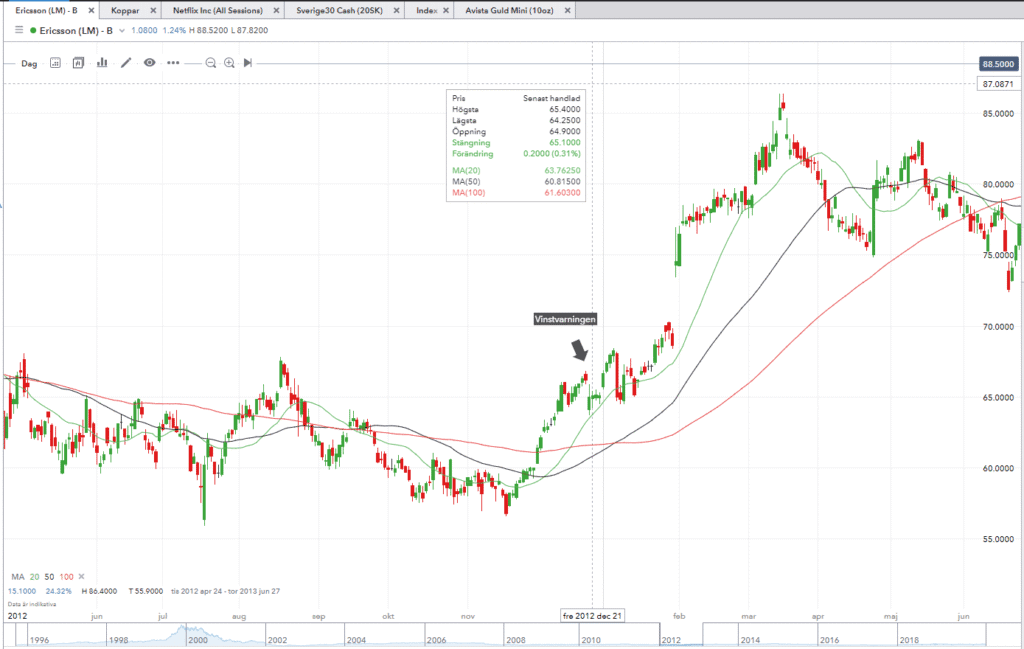
The arbitrary nature of when a profit warning should be issued was clearly demonstrated when Ericsson chose not to issue one in 2012, despite profit reaching only 1/3 of the expected level. Financial commentator Claes Hemberg reacted strongly, as did many shareholders. A few minutes after the market opened, the share price had plummeted 14%.
According to the company’s CEO, Hans Vestberg, the profit warning was not relevant, and he commented that the worsened result should be seen as an “investment to increase our leadership in this industry.”
Due to the large discrepancy in profit, the Stockholm Stock Exchange decided to investigate the case to determine whether the company should have issued a profit warning or not.
Zalando 2018 – Too warm a summer
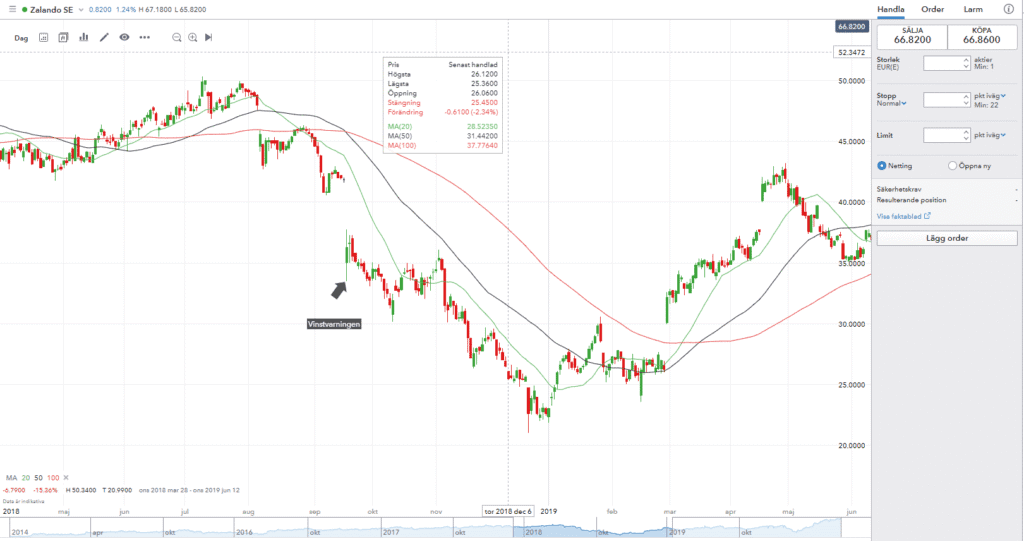
In the autumn of 2018, the clothing company Zalando issued a profit warning and lowered its forecast for expected profit for that year. They stated that the operating profit was expected to be 150–190 million euros instead of previous expectations of 220–270 million—a change of about 30%.
The reason for the warning was that the summer of 2018 was unusually long and hot, which hit sales of the autumn collection hard.
“August and September 2018 have been characterized by continued high temperatures across Europe, which has hampered consumer demand” (Press release from Zalando).
In the press release, however, the company pointed out that it was performing “better than the overall clothing fashion market.”
Ryanair 2019 – Lower flight prices
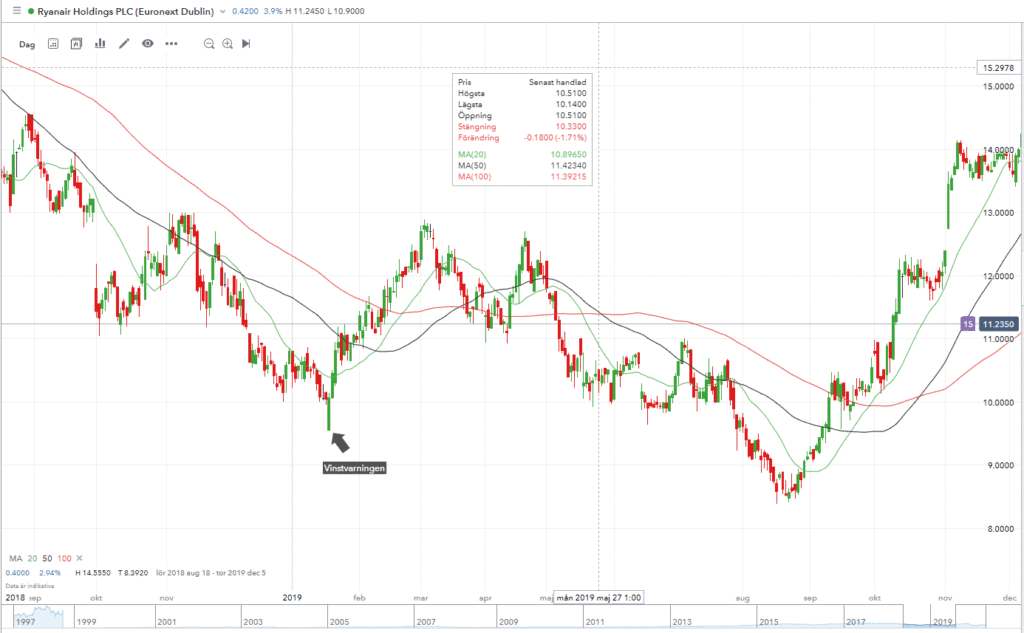
At the beginning of 2019, the airline Ryanair issued a profit warning and lowered its profit forecast from 1.1–1.2 billion to 1.0–1.1 billion—a change of about 10%. The reason was primarily lower flight prices during the winter months. They stated in the warning that prices were expected to fall by 7% instead of the previously expected 2%. In other words, a negative development that could continue to affect the company’s profit. However, the airline had stronger traffic growth than expected.
Kesko 2020 – The Corona pandemic
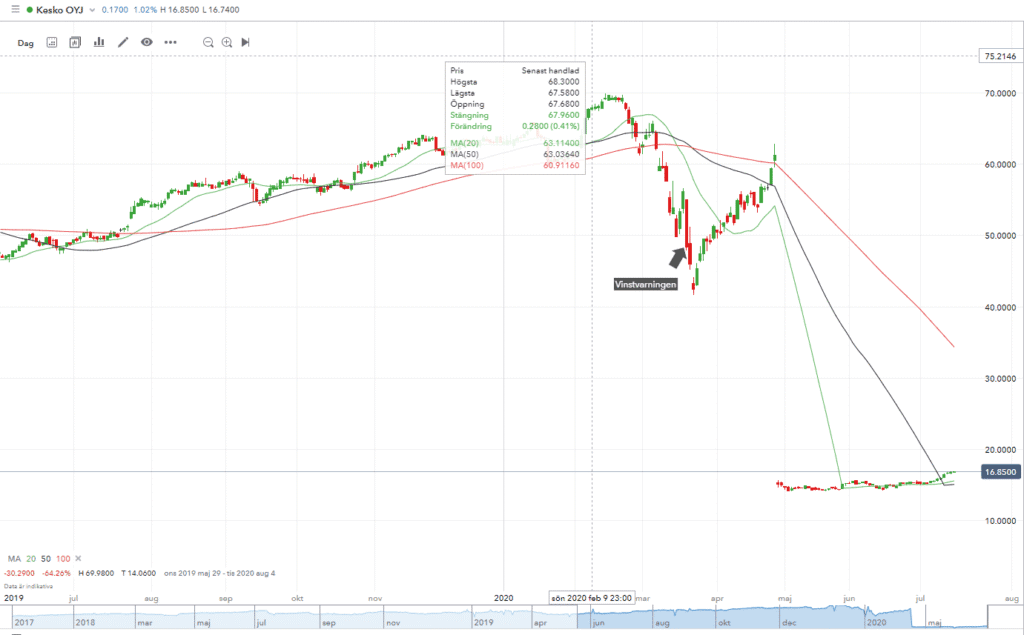
The Finnish retail company Kesko issued a profit warning in March 2020. The warning stated that the operating profit for 2020 was expected to be 400–450 million euros, compared to 469 million euros the previous year—a change of about 10%. The reason for the profit warning was the Corona pandemic, which severely affected the stock market in March 2020, not least due to concerns about how long the pandemic would last.
What information should a profit warning contain?
Similar to the fact that there is no clear threshold for when a profit warning must be published, there are no specific rules for what it must contain. However, it must be clear that the profit is expected to be lower and provide a reason for this.
How is the share price affected?
As a rule, the share price is negatively affected by a profit warning and positively by a positive profit warning. But it depends partly on what lies behind the warning. Is it a one-off event that will not affect the company’s future economic development, or is it a trend that implies lower profit for coming years as well?
Can also affect companies in the same industry
Depending on the reason for the profit warning, a warning can affect not only the company’s share price but also other companies in the same industry. The image below shows how a profit warning from the Finnish industrial group Wärtsilä affected its share price. The warning stated that order intake from the marine sector had decreased sharply during the autumn of 2019, when the global economy was generally slowing down. A Swedish stock that “followed” the decline was Alfa Laval, which also has exposure to the marine sector.
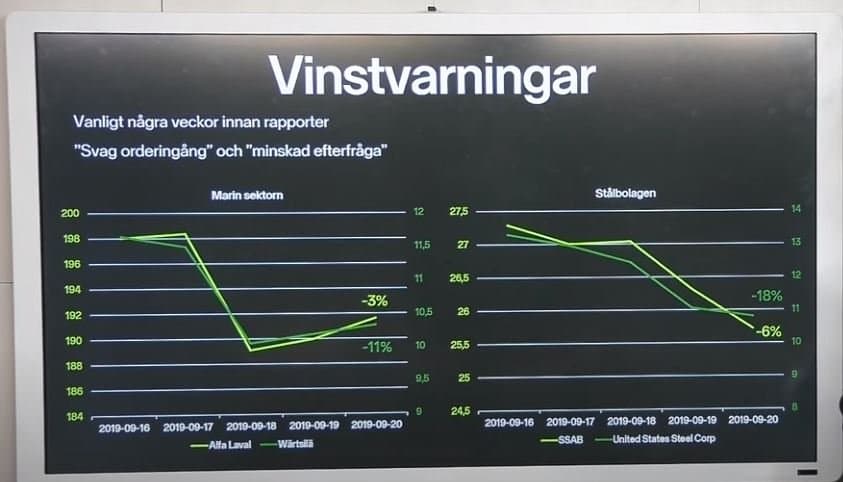
An even clearer example mentioned in the video below is when the American company United States Steel Corp issued a profit warning, which caused SSAB’s share price to fall.
Does it create a buying or selling opportunity?
It is not uncommon for profit warnings to result in an overreaction in the market, i.e., a sharp decline. Long-term investors may therefore see this as a buying opportunity. But everything depends on what is behind the profit warning and how the company is expected to handle this worsened result. If they can return to the same profit levels relatively quickly, it may be a golden buying opportunity. If, however, it is a warning of a longer period of worsened results, it is not an obvious buying opportunity.
- What is the cause of the profit warning?
- Can it be seen as a one-off event or a market trend?
- How does the company communicate the solution they have chosen?
As always with company reports, it is important to look at the cause behind the positive/negative figures and draw conclusions about how this affects the company in the long term.
Frågor och svar
A profit warning is an official announcement from a company stating that its earnings will be significantly lower than what analysts previously expected. It serves to inform investors of a changed financial situation before the formal quarterly report is released.
A positive profit warning occurs when a company announces that its earnings are expected to be significantly higher than market expectations. This is generally viewed as a positive signal for the share price.
Companies typically publish a profit warning 1–3 weeks before their scheduled quarterly financial report. This timeframe is chosen because it is close enough to the report that no major economic changes should occur in the interim.
Yes, if a company’s financial results deviate significantly from previously disclosed information, it may constitute insider information that must be disclosed promptly to the market. However, there is no exact numerical threshold for when this must occur; it is the company’s responsibility to interpret the deviation.
A profit warning typically leads to a negative reaction in the share price, while a positive profit warning often causes the share price to rise. The severity of the reaction depends on whether the market views the underlying cause as a one-off event or a long-term trend.
Yes, a profit warning can impact other companies in the same sector if the underlying cause suggests a broader market trend. For example, if a company reports lower demand in a specific industry, competitors with exposure to that same sector may also see their share prices decline.
Not necessarily. Long-term investors may view a sharp decline following a profit warning as a potential buying opportunity if they believe the issue is a temporary, one-off event rather than a permanent decline in the company’s profitability.
While there are no specific regulatory rules for the exact format, a profit warning must clearly state that the profit is expected to deviate from previous expectations and provide a clear reason for this change.
If a company fails to disclose significant negative deviations that meet the criteria for insider information, it may face scrutiny from stock exchanges or regulators. For instance, the Stockholm Stock Exchange has previously investigated companies when the market suspected a warning should have been issued.
No, the same principles apply if a company expects to incur a significantly larger loss than previously anticipated. The core requirement is to inform the market when the financial position deviates significantly from what was reasonably expected.
No comments yet