
Stock Robots · Best in Test

All analyses, articles and other information on this website are presented for informational purposes only. None of the content should be interpreted as professional financial advice, investment recommendations or invitations to buy or sell securities. We are not registered as financial advisors under Swedish legislation, and our content therefore does not fall under the rules for financial advice to consumers.
Investment decisions should be based on careful analysis and professional advice from qualified financial experts. We strongly recommend that you consult an independent financial advisor before making important investment decisions. Remember that all investments involve risks - your capital can both grow and decrease in value, and there is no guarantee that you will get back your original investments. Past results say nothing about future returns.
By using this website you accept that we cannot be held responsible for any economic losses or damages that may arise based on the information here.
On this page we recommend some products and services that we like ourselves. It could be books, magazines or online banks (IG, Avanza or Nordnet for example). Sometimes when we recommend something we get a commission and that's how we make money to have resources to keep the site running.
We think it's very important to stand behind what we recommend so the site only contains links to companies and services that we think are really good.
When we create content, we use AI as an aid for proofreading, spelling and drafting text.
All our articles are always reviewed and approved by a human before they are published, to ensure that we follow our editorial guidelines.
Table of Contents
Stock robots are digital services that automate investments, primarily in stocks. Through initial settings, the user creates the parameters the robot should “work” from. These settings determine which stocks the robot buys. Today, the term “stock robot” is often used as a collective name for both pure stock algorithms and smart fund robots—automated investment services that you can read more about later in the article.
Two ways to save in stock robots:
-
Long-term savings (Passive management): Here, the goal is secure and automated risk diversification over time. Through market-leading robo-advisory services, you get a portfolio that manages itself, reinvests dividends, and adjusts risk according to the market. It is the easiest way to get “professional management” at a very low fee.
-
Short-term savings (Active trading): For those who want to work with technical analysis and quick trades, trading robots are used. By connecting tools like MetaTrader 4 to a platform like IG, you can let algorithms buy and sell stocks or CFDs the moment your preset conditions are met.
What is a stock robot?
There is no exact definition of what a stock robot is. Some services are called “stock robots” while others have similar functions without using that specific word.
It is important to mention market-leading robo-advisors. Formally, these are fund robots, but for you as an investor, they function in practice the same way as a stock robot. The big difference is that they package your investments into broad, low-cost funds instead of buying individual stocks.
Common denominators for stock robots and fund robots
Before we dive into the specific platforms, it is important to understand what unites these services. Regardless of whether you choose a pure stock robot or a broader fund robot, they are characterized by the following four pillars:
-
Personal settings and risk profile
Before you deposit capital, you undergo a digital advisory process. By answering 5–10 questions about your finances, savings horizon, and attitude toward risk, a personal profile is created. These settings then constitute the robot’s “instruction manual”. -
Algorithm-driven selection of assets
It is the robot – not you – that chooses exactly which stocks or funds the money should be placed in. By relying on data-driven analysis and mathematical models, human factors like stress, emotions, or temporary market trends are eliminated. -
Fully automatic trading
The whole point of a robot is convenience. Once you have started a monthly savings plan or made a one-time deposit, the service handles everything. Capital is invested continuously in the predetermined assets without you needing to log in and approve every purchase. -
Different strategies for value creation
What primarily distinguishes the services is how they try to create returns for you:-
Analysis of key ratios and mathematics: Instead of guessing, some services use advanced algorithms to analyze the fundamental health of companies.
-
Broad market exposure: Many robo-advisors focus on maximum risk diversification at low fees via thousands of underlying assets.
-
eToro’s CopyTrader – Follow skilled investors
-
Follow eToro’s best investors
-
Follow the investments they buy for themselves
-
Copied investments are replicated in real-time in your portfolio
-
No extra cost to use the CopyTrader function
-
Social trading – chat and comment on performance
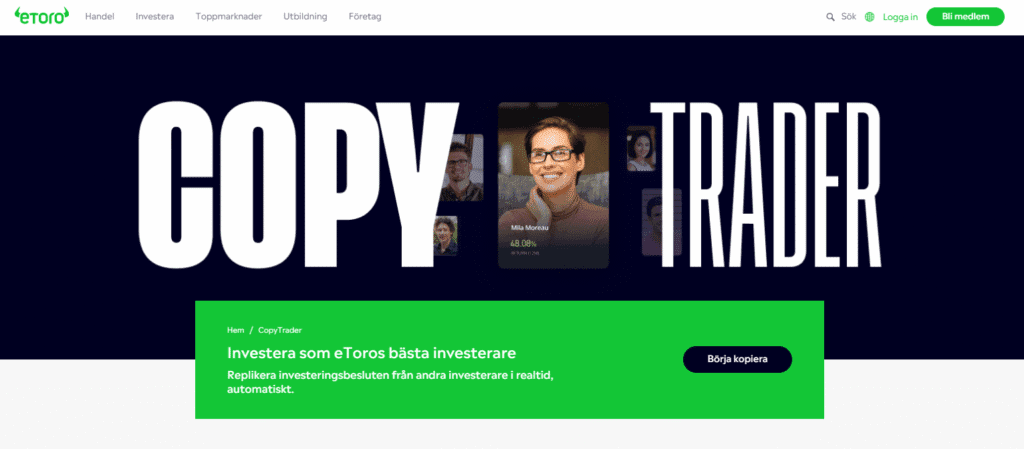
“CopyTrader, eToro’s most popular feature, lets you see what real traders are doing in real-time and copies their trades automatically” /eToro.com
How it works
eToro.com offers the world’s largest platform for so-called “social trading”. Many use eToro for private investments in stocks, commodities, and currencies – with or without leverage. One of the more popular services is eToro CopyTrader.
Anyone with an account on eToro can choose to make their profile public, which means all other members can see their profile, portfolio, and performance over time.
Search for a profile on eToro that has generated good returns over time at a reasonable risk level, and then “copy” that person’s holdings. Via CopyTrader, you select who to follow and what amount (minimum 200 USD) to invest. The amount is automatically invested in the assets the investor has in their portfolio. If the investor sells/swaps holdings, this will also happen in your portfolio, proportionally based on the amount invested.
All positions created automatically can also be edited, for example, closed manually via stop-loss. The stop-loss function is not guaranteed at eToro in the event of slippage.
How returns are expected to be created
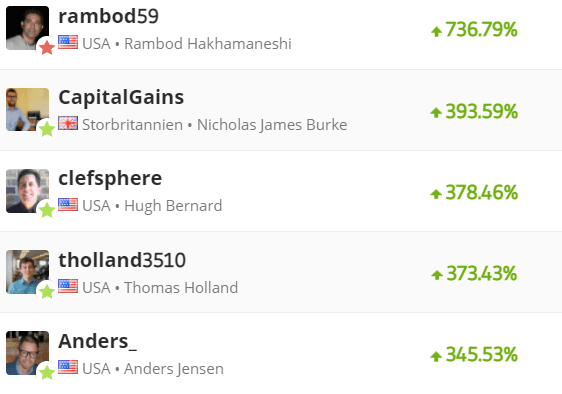
eToro has millions of users/investors. Naturally, some perform significantly better than others. By looking at statistics and using filters, it is possible to find investors who have had higher returns than the index for many years in a row.
Returns are thus expected to be generated by these investors maintaining their good performance and by their holdings being “copied” via CopyTrading.
However, it is important to remember that investors on eToro have no specific rules to adhere to. They can therefore change their focus and risk level “overnight”.
Suitable for…
eToro’s CopyTrading is suitable for people who appreciate “social trading”. Through the platform, different investments can be discussed, and comments can be left for investors who have followers (copiers).
A disadvantage, however, is that trading on eToro.com takes place in a standard taxable brokerage account, not a tax-advantaged account like an IRA or 401(k). You are responsible for reporting your capital gains and losses to the IRS according to local tax laws.
Metatrader 4
-
Stock robot with plenty of settings
-
For short-term trading
-
Advanced tool!
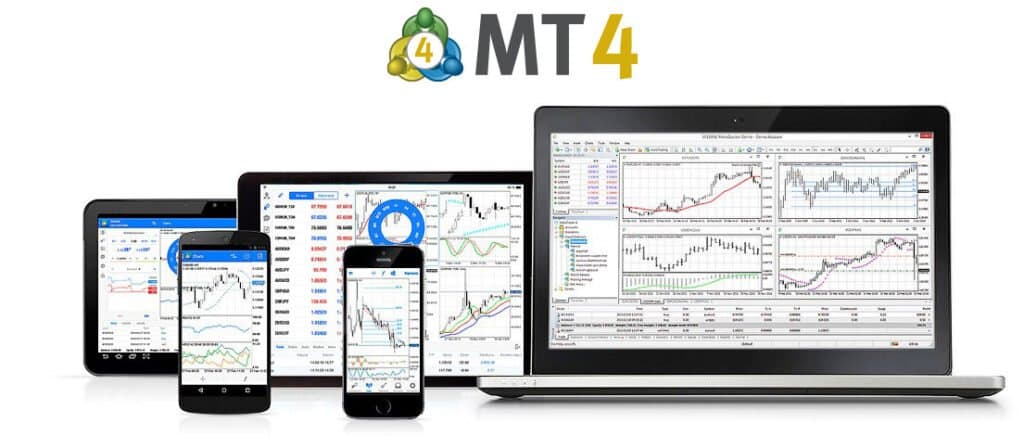
“Discover the power of automated trading that MetaTrader 4 gives you – with a world-leading trading provider” / IG-Market & MetaTrader
How it works
MetaTrader 4 is an advanced trading platform for automated trading. The platform is primarily associated with currency trading, but it is also possible to trade in, for example, stocks, CFDs, and cryptocurrencies. With plenty of analysis and setting options, it is possible to create algorithms that open/close positions if predetermined events are met.
You can download Metatrader for free if you have an account at IG.com (which is also free)
How returns are expected to be created
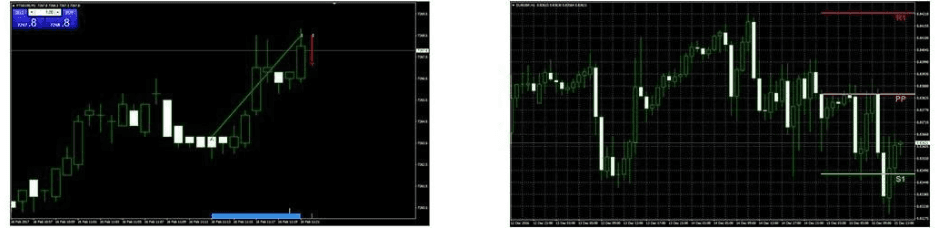
Technical analysis means that price movements are analyzed based on trends and market psychology rather than economic events that affect the asset’s value. There are plenty of different tools for conducting technical analysis, and generally, it involves holding positions for a shorter time.
With MetaTrader 4, technical analysis can easily be performed, and then the parameters that must be met for trading to occur are specified. In this way, MetaTrader 4 is expected to automate trading and can thus be classified as a stock robot – even if trading can take place in several different assets.
Suitable for…
MetaTrader is only recommended for people who are very well-versed in day trading/swing trading and want to take their trading to the “next level”. This is an advanced tool that is not adapted for beginners.
Fund robot – alternative to stock robot
-
Investment based on risk profile
-
Automatic risk distribution
-
Within a brokerage account
An alternative to a stock robot is to invest capital via a fund robot. These “robots” work in the same way as Sigmastocks’ stock robot, but the investment instead takes place continuously in funds. A simple way to save monthly in funds – with automatic risk balancing.
How it works
Registering an account with a fund robot is both free and easy. Usually, identification is done via standard multi-factor authentication, after which the account can be up and running in a minute.
The first step is to answer questions about your view on investments, risk level, and whether certain funds should be excluded from the selection. Based on these factors, the fund robot creates a mix of funds that fits the investment profile created.
The second step is to deposit money into the robot. This can be done via one-time deposits, but many instead choose a continuous monthly savings plan. Capital that comes in is automatically distributed among the various funds that the portfolio consists of.
Once a year, automatic rebalancing of the holdings also takes place, which means that the percentage distribution between the funds returns to the original level.
How returns are expected to be created
Investing via a fund robot is arguably the easiest way to achieve very broad risk diversification. Each fund has a large number of stocks, and the fund robot creates a portfolio of several different funds. Primarily, these are also index funds that create risk diversification by not being focused on a single industry. In addition, annual rebalancing takes place so that no fund “weighs too heavily” in the portfolio.
Research also shows that a risk-adjusted portfolio performs better in the long term, and is cheaper, than actively managed industry funds.
Suitable for…
Fund robots are suitable for those who save long-term and are not expected to change funds in their portfolio for many years. The robot can just as well be used as a “base in the savings portfolio” as it can be the only form of savings used.
Warning about trading robots!
So-called trading robots are often marketed as “automatic stock robots”. However, they should not be confused with the automatic stock trading described in the services above.
How it (does not) work
A free account is created, and money is deposited via card payment. A common setup is then that the money can be seen in the logged-in view. There, you can also see how much the capital grows day by day. This without the person investing needing to know anything about stocks or understand how the robot actually works.
In the vast majority of cases, however, it is a matter of fraud where people are lured to invest with promises that it is “so easy that anyone can invest” while the return is several hundred percent. But withdrawals are rarely possible to carry out – because it is all made-up numbers.
This form of fraud is unfortunately common, and financial regulators worldwide frequently publish warnings about such investment scams.
(There are also legal trading robots – however, the gut feeling is not particularly good for these)
How returns are (not) created
In the marketing of these stock robots, it is stated that advanced algorithms read the movements of the stock market and utilize these automatically. Through extremely fast trading, daily profits are taken, whereby the value of the invested capital increases. Very often, returns of 1 – 2% per day are mentioned, which would mean approx. 350 – 700% annual return.
A large part of these so-called stock robots are on warning lists maintained by financial regulators globally.
No investment service can promise returns, and when there are promises of extreme returns, it should absolutely be seen as a strong warning signal.
We do not recommend trading robots
We do not recommend automated trading robots to anyone. The hunt for extremely high returns usually ends with no returns at all.
Frågor och svar
A stock robot is a digital service that automates your savings by placing money in a broad portfolio of securities. Based on your answers regarding goals and risk appetite, the robot creates an optimal distribution between stocks and fixed income. It then handles continuous rebalancing so that your portfolio maintains the desired risk level over time without you needing to be active.
The biggest advantage is that the robot eliminates human emotions, which prevents you from making hasty decisions during market turmoil. Through automated risk diversification and low fees, you get a professionally managed portfolio without having to spend much time. This means your savings manage themselves around the clock using a scientifically grounded method.
Most Swedish stock robots offer savings via an investment savings account (ISK), which is tax-efficient for most private individuals. Instead of paying tax on every profit, you pay an annual standardized tax on the entire capital. This also simplifies the tax return significantly because the robot automatically reports all necessary information to the Swedish Tax Agency (Skatteverket).
A fund robot usually focuses on long-term savings in broad index funds with low risk and good diversification. A trading robot, on the other hand, is programmed to execute frequent trades in individual assets based on technical signals. While the fund robot suits most savers, trading robots often require more technical knowledge and generally involve a higher risk profile.
The robot uses algorithms often based on modern portfolio theory to find an efficient return in relation to risk. By analyzing the market, it selects cheap and broad index funds that provide exposure to various markets globally. The choice is entirely governed by the risk profile and savings horizon you specified when you started the service.
Yes, reputable actors in Sweden are under the supervision of the Swedish Financial Supervisory Authority (Finansinspektionen) and are covered by both the deposit guarantee and investor protection. This means your assets are protected if the institution were to go bankrupt. However, it is important to remember that market risk always exists, which means the value of your investments can both increase and decrease.
The total cost for a stock robot is usually between 0.30% and 0.90% per year. This normally includes both the robot’s own management fee and the underlying fund fees. Since robots usually choose cost-effective index funds, it is in many cases significantly cheaper than buying actively managed funds at a traditional major bank.
Most stock robots monitor your portfolio daily and perform an automatic rebalancing when the distribution between asset classes deviates too much from your original plan. If stocks have increased significantly in value, the robot sells a portion and buys fixed income to restore the balance. This ensures that your chosen risk level remains intact over time.
Yes, you generally always have access to your capital and can request a withdrawal whenever you want. It usually takes a few banking days for the robot to sell off your holdings and transfer the money to your linked bank account. There are normally no hidden fees or lock-in periods for ending the service or withdrawing parts of the savings.
A stock robot is an excellent tool for both beginners who want help getting started and experienced investors who are looking for a passive part of their portfolio. For those who do not want to spend time analyzing individual companies or market trends, the robot offers a simple solution for building wealth with minimal effort.
No comments yet